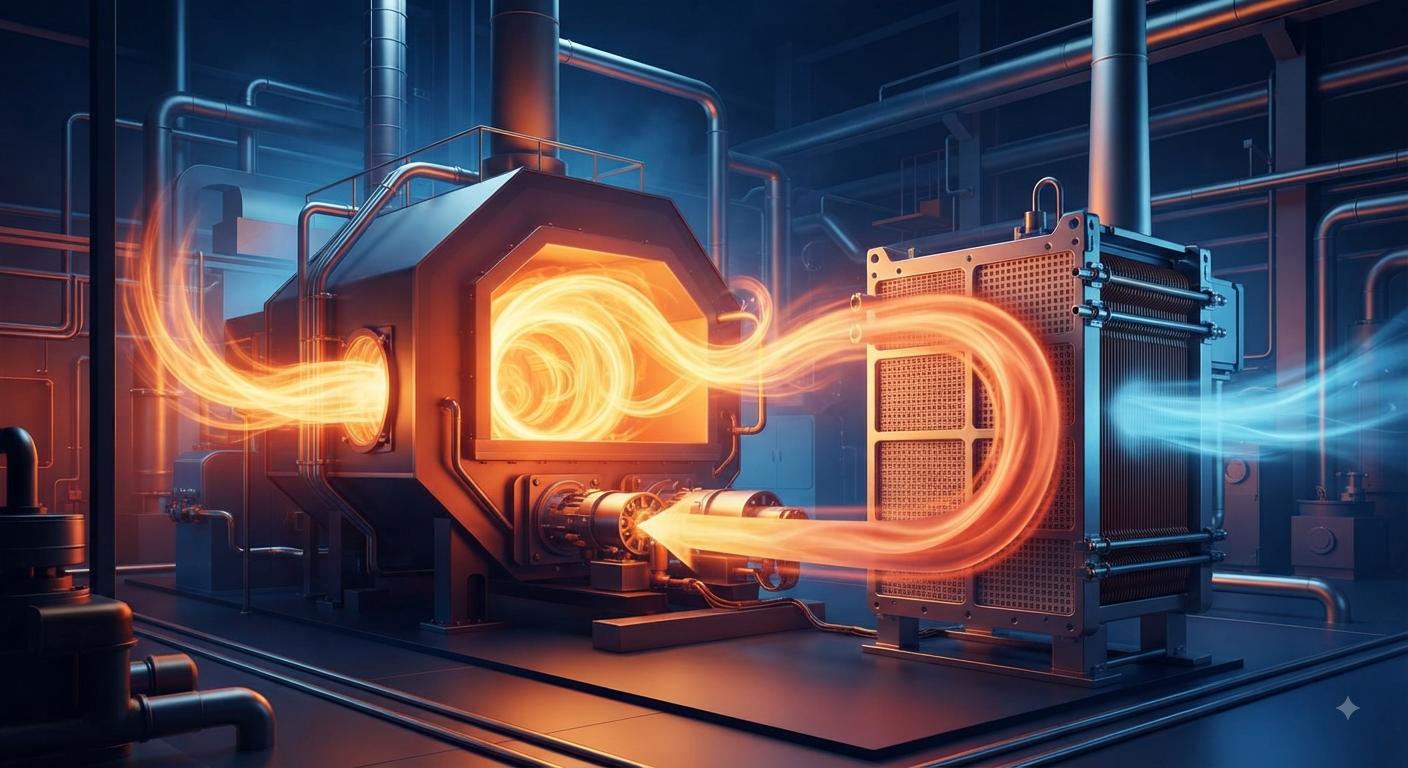

A paradoxical situation occurs in many high-temperature industrial processes: fuel is burned to generate heat, part of that energy is used in the process, and a significant fraction subsequently leaves the system through still-hot combustion gases.
In other words, part of the energy the company has already paid for ends up going out through the stack.
This is highly relevant worldwide in furnaces and other thermal equipment, where combustion gases can leave the heating chamber still carrying a considerable amount of energy. Improving the efficiency of these processes, therefore, does not depend solely on switching energy sources: it also means asking what we do with the heat before discarding it.
That is where two fundamental concepts come in: heat recovery and heat regeneration.
What does recovering or regenerating heat mean?
Both technologies start from the same idea: capture a fraction of the energy a thermal process would normally discard and return it, directly or indirectly, to the process.
They do not, however, work the same way.
In heat recovery, the hot gases coming from the process continuously transfer part of their energy to another stream through a heat exchanger, commonly called a recuperator. That energy can be used, for example, to preheat the air later used for combustion, though it can also heat a raw material or another process stream.
The logic is straightforward:
Hot gases → heat exchanger → preheated air or raw material
This way, part of the energy previously expelled directly through the stack returns to the process, reducing the amount of energy that must be supplied again through fuel.
Heat regeneration pursues the same goal but relies on a different principle. Here, solid elements with high thermal capacity — commonly ceramic matrices — temporarily store the residual heat of the combustion products and subsequently transfer it to the air used in the process.
To achieve this, the system operates cyclically.
During one part of the cycle, the hot gases pass through the ceramic matrix and transfer energy into it. Then a valve system reverses the flow direction and circulates cold combustion air through the previously heated matrix. The air recovers the stored energy before entering the burner. This operating principle — two cycles with a reversal of flow direction — is precisely the one used in the system studied in our research.
So while a recuperative system involves continuous heat transfer between two streams, a regenerative system adds an intermediate stage of thermal storage.
Put simply, the regenerator can be understood as a kind of thermal battery: it takes in energy from the hot gases, stores it briefly, and then returns it to the combustion air.
Why take recovery one step further?
Both recovery and regeneration increase the efficiency of a thermal process compared with a conventional configuration in which the hot products are sent straight to the stack.
Regenerative systems, however, can reach high levels of waste-heat utilization and, in particular, considerably high air preheating temperatures.
The literature reports gas savings close to 50 % with regeneration systems and up to 30 % with recovery, owing to the nature of the phenomenology and the air preheating temperatures achieved.
This suggests a simple progression in how thermal processes use energy:
Conventional process → heat recovery → heat regeneration
Each alternative progressively reduces the amount of energy ultimately lost with the exhaust gases.
In other words, the air the burner requires can enter the process carrying a significant amount of energy that, in a conventional system, would have ended up in the stack.
Why preheat combustion air?
Every combustion process needs fuel and an oxidizer, normally air. When air enters at ambient temperature, part of the energy released by the fuel must be used simply to heat it up to process temperatures.
But if that air enters already heated using energy recovered from the combustion gases, part of that energy demand has already been met.
And most importantly, no additional fuel had to be burned to do it.
That is precisely the logic behind recovery and regeneration: reusing energy that has already been produced and paid for.
Less stack temperature means more energy used
An intuitive way to grasp the potential of these technologies is to look at what happens to the gases before they are expelled.
The higher the temperature at which they leave a process, the greater the amount of thermal energy potentially being wasted.
Recovery and regeneration aim to intercept a fraction of that energy before it reaches the stack.
In a conventional system, the gases are discharged still holding much of their sensible heat. In a recuperative one, a fraction of that heat is transferred through an exchanger to another stream. In a regenerative one, the gases hand part of their energy to thermal matrices that later transfer it back to the combustion air.
The energy logic can be summed up very simply: if we get less energy to leave through the stack, more energy stays available inside the process.
What can this mean for an industrial plant?
Waste-heat utilization should not be understood merely as a strategy for improving an efficiency indicator.
From a production standpoint, recovered energy can be used in two ways:
- The first is to maintain the same output using less fuel.
- The second is to use the additional available energy to increase the thermal or productive capacity of the process.
Both possibilities appear documented in the background reviewed in our research. As noted above, there are industrial regeneration applications that have reported fuel savings above 40 % compared with systems without regeneration. Other studies on heat recovery through air preheating reported efficiency increases from 32.7 % to 48.5 %, associated with a 31.3 % reduction in fuel consumption or, alternatively, a potential 51.3 % increase in production.
These figures correspond to specific technologies, furnaces, and operating conditions and should therefore not be read as guaranteed savings for any installation. They do, however, show the magnitude of the potential in making use of energy from streams that are currently discarded.
Efficiency and decarbonization can start in the same place
Much of the current discussion on industrial decarbonization focuses on replacing energy sources: electrification, hydrogen, biogas, and lower-carbon fuels are all relevant alternatives.
There is, however, a question that should be asked even before switching fuels: how efficiently are we using the energy we already consume?
A reduction in fuel consumption resulting from waste-heat utilization can directly lower the emissions associated with the process. That makes energy efficiency and decarbonization not necessarily independent strategies.
The research carried out on the crucible furnace also showed that sensible heat losses associated with combustion gases can be mitigated through heat regeneration.
For that reason, recovering or regenerating heat can be a first level of intervention in many thermal processes: before changing the energy source, make better use of the energy available. And both strategies can be combined later on.
This opens an interesting perspective: developing thermal equipment that not only consumes less energy but can also adapt progressively to lower-carbon fuels.
Waste heat can be a resource
For decades, in countless industrial thermal processes, the stack has been simply the end point for combustion products.
Heat recovery and regeneration invite us to see it differently.
A gas leaving a furnace at high temperature is not merely process waste. It is also an energy stream.
The question then stops being how much heat a burner produces and becomes how much of that heat the process actually uses before releasing it to the environment.
Recovering part of that energy through a heat exchanger, or storing it temporarily in a ceramic matrix to return it to the process later, reduces energy losses and opens opportunities to cut fuel consumption or increase productivity.
Waste-heat utilization is therefore not simply about adding a component to a furnace. It is about changing the energy logic of the process: instead of producing, using, and discarding heat — produce, use, recover, and use again.
And in an industry where energy is simultaneously a production cost and a source of emissions, the cheapest heat may well be the heat we do not need to produce twice.